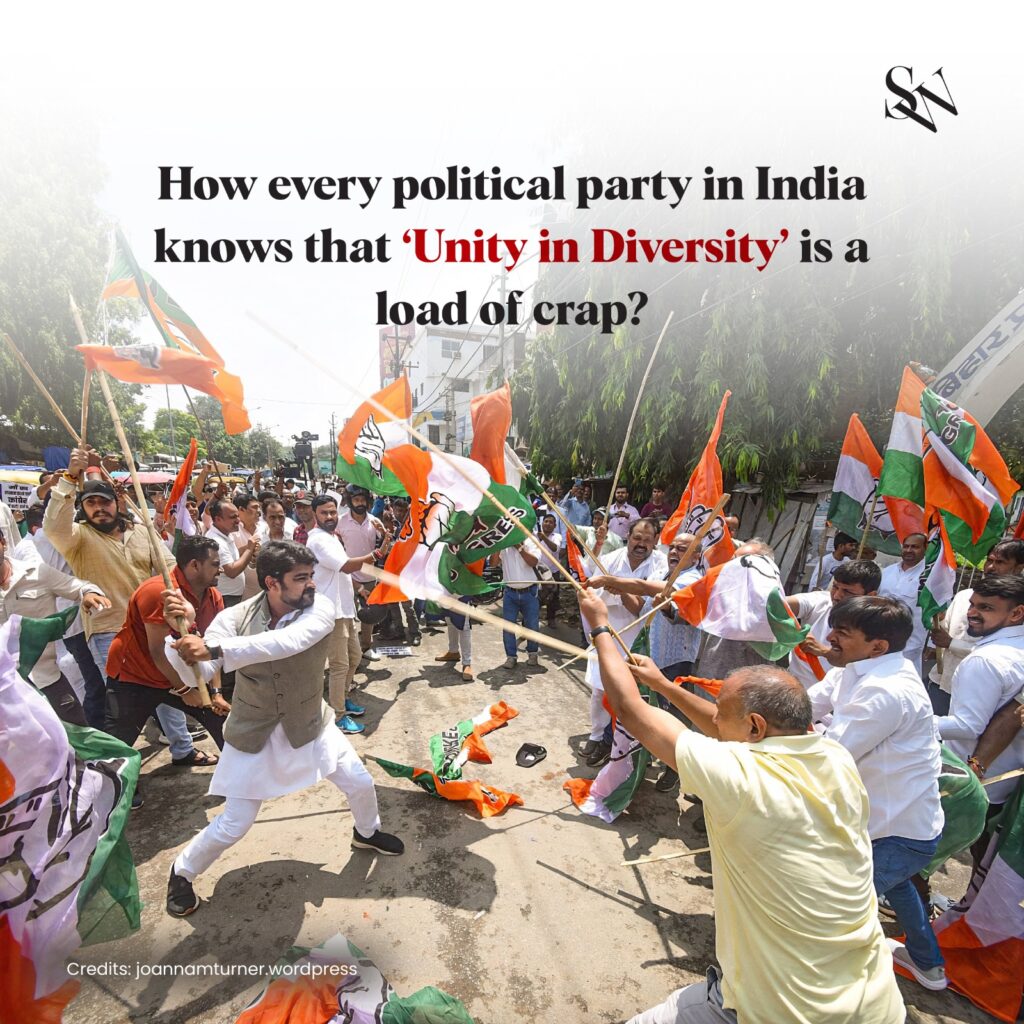
‘Unity in Diversity’ is India’s most famous PR slogan, repeated in textbooks, Independence Day speeches, and embassy brochures.
But scratch the surface, and you’ll find this: every single political party in India profits more from our divisions than from our boring unity.
And they’ve been doing it since before independence.
If we were truly united, politics would be boring (and bankrupt)
A genuinely united India across caste, religion, region, and language would vote on roads, jobs, and healthcare.
But that doesn’t help politicians.
Because development is hard to deliver, but division is easy to sell.
So, parties manufacture fault lines to slice voters into digestible chunks:
- Congress played the secular-minority card for decades
- BJP dials up the Hindu-Muslim binary like a Netflix special
- Regional parties carve vote banks out of caste identities like butcher’s cuts
- Left parties weaponize class, while ignoring caste tensions altogether
Unity makes voters rational. Diversity makes them emotional.
And emotions always win elections.
How ‘Unity in Diversity’ became the most recycled lie in our civics textbooks?
Let’s time-travel to 1947.
The country was a volatile mix of 562 princely states, thousands of dialects, hundreds of castes, and deep religious wounds.
Yet instead of confronting this fragility, the slogan was used like a band-aid over a bullet wound.
What we got was a synthetic unity, stitched by institutions, rituals, and shared trauma.
Today, politicians repeat it for optics, not outcomes.
Because the moment we actually act united, say, protest unemployment across castes, political parties panic.
Why?
Because real unity dilutes vote-bank segmentation.
And without that, most political parties wouldn’t survive even one election cycle.
What the data and history tell us (that no party wants you to know)?
- Over 90% of Indian politicians win their seats in regions where caste and religious identity voting is dominant.
- No Prime Minister has ever come to power without leveraging one major identity group to the exclusion of others.
- Manifestos rarely promise unity. They promise representation code for: we’ll protect your group’s pie.
Remember the Mandal Commission riots?
Or the Ram Janmabhoomi movement?
Or how OBC vs Dalit vs SC vs ST vs Upper Caste dynamics define local elections?
One may argue, what about the other side?
Honestly, no one’s docile than the other. In Indian politics, we are reaching a point where one will vote depending on who’s less worse.
The hidden truth no textbook will teach you
Politicians want predictable polarization.
They don’t fix division because they profit from managing it.
It’s like a landlord who never fixes the leak but keeps charging rent.
Division is the very nature of the system.
Why you’re only reading this on Social Winds?
Mainstream media won’t touch this.
They live off political ad money, sponsored columns, and Lutyens access.
But here at Social Winds, we’re selling arsenals for the smartest people in the room or the wannabes.
If this blog punched a hole in something you took for granted, good.
That’s what we do.
If this opened your eyes, we’re soon gonna roll out the tools to sharpen your mind even further.
Coming soon:
- Starter Packs: Understand Indian politics beyond memes
- Rebuttal Decks: Win the next family WhatsApp fight with facts, not rage
- Context Drops: Weekly doses of underreported truths, decoded
- Narrative Watchlists: What’s being spun and what’s being buried
Stop doomscrolling random content.
Start arming yourself with context that actually matters.
Closing whisper
The only reason India hasn’t united is that every party has too much to lose if it does.