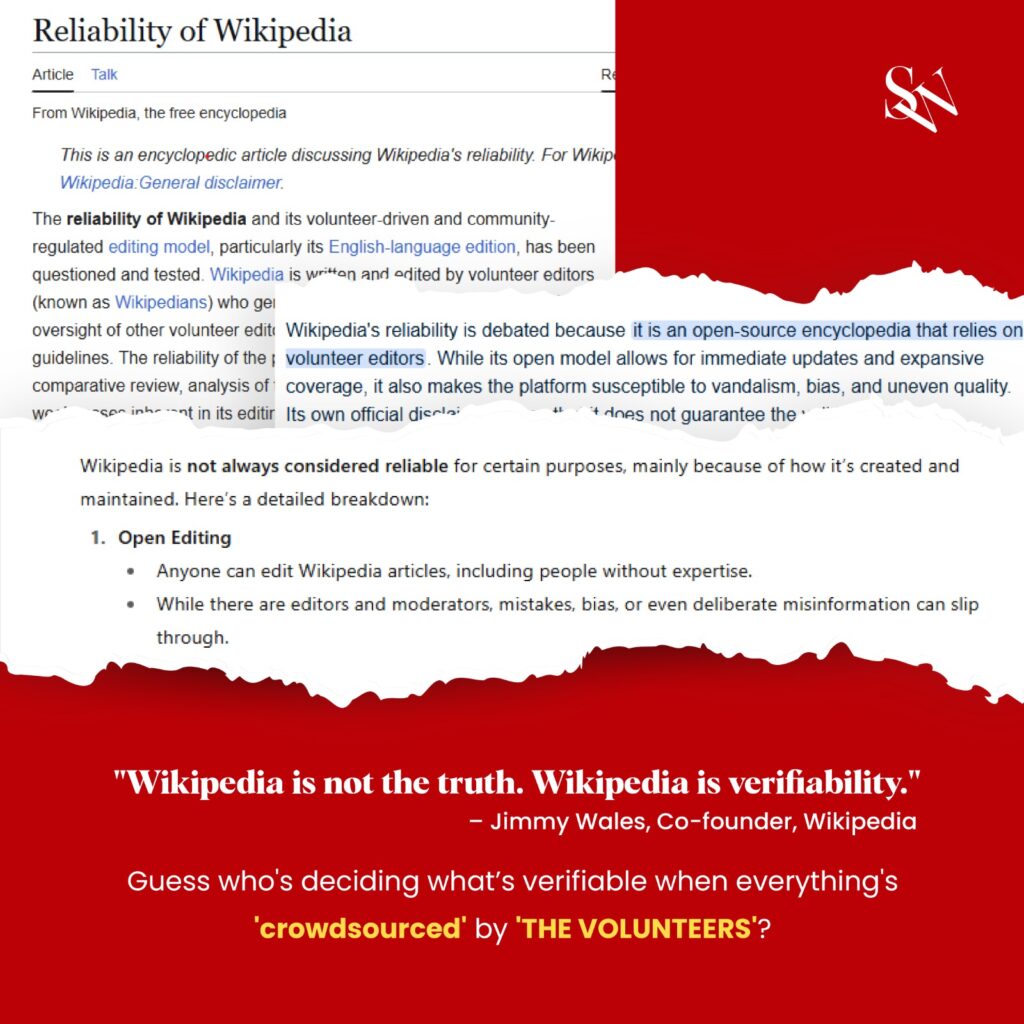
“Wikipedia is not the truth. Wikipedia is verifiability.”
Jimmy Wales, Co-founder, Wikipedia
Let that sink in.
The internet’s favorite encyclopedia doesn’t promise truth. It promises verifiability. And guess who gets to decide what’s verifiable? You’re not going to like the answer.
A revolution of knowledge, or just a hall of mirrors?
Wikipedia was meant to be a digital utopia; truth crowdsourced by the masses. But somewhere between idealism and reality, it became a so-called gatekeeper of truth, weaponized by those who know how to game its rules.
And here’s the catch: You probably trust it.
- Over 70% of college students cite Wikipedia at least once a semester.
- Voice assistants like Siri, Alexa, and Google often quote it as gospel.
- Even media outlets and researchers begin with it.
But behind that familiar black-and-white interface lies a world run rather by a strange elite of anonymous editors, invisible hierarchies, and soft power battles.
Truth by committee: How Wikipedia actually works?
Let’s bust the fantasy.
- Wikipedia is written by volunteers. Over 77% of all edits come from just 1% of users.
- Many of these editors use pseudonyms, remain anonymous, and hold no subject-matter expertise.
- The most powerful among them are editors with high revert power: the ability to delete and overrule changes.
In short, Wikipedia is governed by those who stay online the longest.
Verifiability over truth? Does that change something for you?
Wikipedia’s golden rule is to just cite what’s published by reliable sources. But wait:
- Who decides what counts as a ‘reliable source’?
- What if the truth hasn’t yet been published by a mainstream outlet?
For example:
- Indian sources like OpIndia or Swarajya are flagged as biased. But outlets like The Wire or NDTV are not.
- Western sources like the New York Times or BBC are seen as neutral, even when their own histories are riddled with retractions and bias.
Weaponizing Wikipedia
A few facts that should rattle you:
- Editors from the U.S. State Department and political parties have made thousands of Wikipedia edits.
- In 2016, the Clinton campaign was accused of quietly editing her Wikipedia page.
- Pharma companies have scrubbed controversies and clinical trial results.
- In India, political fan groups frequently wage war over who gets to write the history of recent events.
Still think it’s a neutral ground?
The psychological trap
Wikipedia exploits something basic: cognitive laziness.
- We see structure, citations, and clean formatting.
- Our brain reads: credible, safe, unbiased.
But this design hides the chaos behind the scenes. Every sentence, every word has likely survived a digital tug-of-war.
So, what the hell now?
Use Wikipedia as a launchpad.
- If a claim matters to you, chase the source.
- Look for what isn’t on the page: perspectives excluded, citations flagged, and edits reverted.
- When you see a clean narrative, ask who it serves.
This is what real digital literacy looks like. Not passive consumption, but active suspicion.
And, why we made this?
At Social Winds, we believe the smartest person in the room is the one who knows which facts are allowed to survive. Our content craves ripping open the headlines.
We’re building tools for people who want:
- Rebuttal decks for debates
- Starter kits that explain not just what happened, but why it matters, just making it very contextual for you
- Thought raids that arm you for group chats, meetings, and arguments with that one WhatsApp uncle
- Stories or perspectives that never or couldn’t cross your feed
- And a whole lot of assets for you to feel armed with contexts.
Things are in progress, we shall keep you posted.
Closing whisper
“Wikipedia is simply too polite to call the bias what it is.“