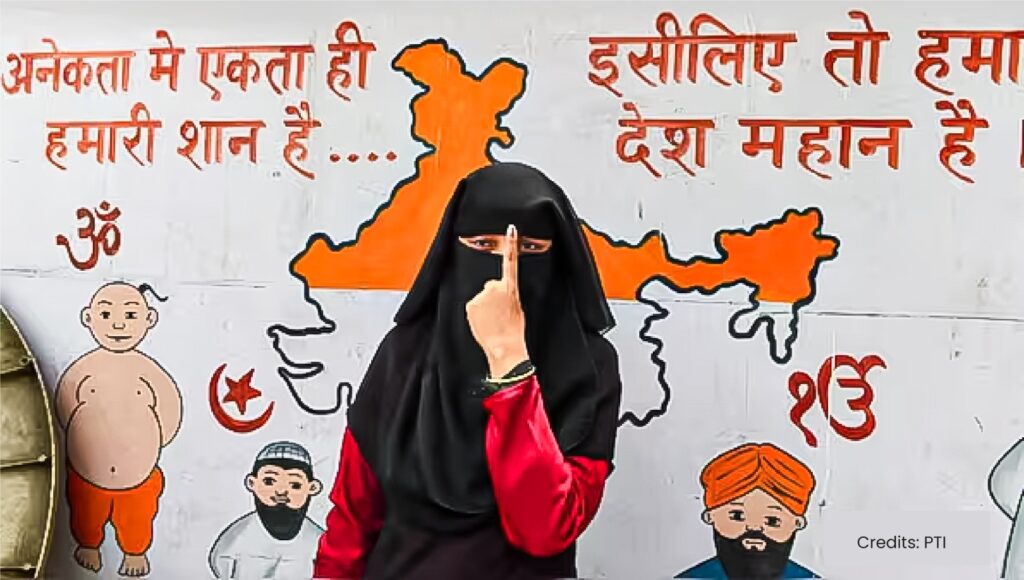
Somewhere between ‘Sarva Dharma Sambhav‘ (equal respect to all religions) and ‘the state has no religion‘, India decided to cook its own version of secularism.
And like most things that start with noble intentions here, it slowly turned into… a khichdi. Basically, a mushy, overcooked, everyone’s-invited meal that nobody really enjoys but everyone pretends is ‘for the greater good.’
Let’s be honest. In theory, India’s secularism sounds beautiful, poetic even.
In practice? It’s an ideological buffet where the state keeps serving everyone selectively while calling itself neutral.
The textbook recipe VS the reality show
Articles 25 to 28 of the Indian Constitution basically outline that the state:
- Shall have no religious identity,
- Shall maintain equal distance from all faiths, and
- Shall never use public funds to promote any particular religion.
Sounds clean. Sounds fair. Sounds progressive.
But step into the real world, and suddenly the same secular state is funding Hajj, managing and controlling temples, paying for madrasas, bringing communal violence laws that straightaway benefit only the minority clans, and sometimes even interfering in who can or can’t enter certain places of worship.
Imagine secularism being a sport. India would be simultaneously the referee, the player, and the team sponsor.
The political remix
Here’s where it gets interesting: ‘secularism’ in India, more than a philosophy, feels like a strategy.
The right uses it to call out hypocrisy.
The left uses it as a moral crown.
And the center… just tries not to get trampled while the two sides fight over who’s the real secularist.
Every election season, ‘secularism’ becomes less about equality and more about arithmetic: how many votes a selective outrage or selective silence can effectively fetch.
When temples are taxed but churches and mosques aren’t, when subsidies exist for one community pilgrimage but not for others, when freedom of religion extends to conversion but not to reform, the line between secular and selective starts to blur.
Feels like India has officially rebranded the entire concept of secularism.
The cultural masala
Now, let’s not pretend this is just a political fault line.
It’s also cultural.
We’re a civilization that worships everything from rivers to cows to concrete to sleepers. Religion to us is not a separate lane here; it’s the main road, the side lane, and sometimes even the GPS that folks for centuries have cushioned upon to guide their spiritual and intellectual journey.
Expecting India to function as a cold, religion-free state is like expecting Twitter to stay neutral during elections, theoretically possible, practically absurd.
So, instead of removing religion from governance, we just made governance look a little bit like every religion at once.
The result? A secularism that means everything and therefore, nothing.
The hypocrisy we all subscribe to!
Let’s face it, India’s secularism works like a mirror: it reflects whatever we want it to.
When our side benefits, we call it inclusion.
When the other side benefits, we call it appeasement.
The secularism we preach is more about emotional convenience than equality.
We’ve made peace with the contradiction because outrage is selective, and neutrality is bad for TRPs.
So yes, maybe India is a secular state on paper, but in practice, it’s a crowdfunded consensus of contradictions.
Is this Khichdi worth stirring?
Here’s the paradox: despite the hypocrisy, this messy secularism somehow works.
It keeps a billion people, of every faith, color, and caste, living under one Constitution. It’s chaotic, inconsistent, and often unfair, but it’s also the reason India hasn’t exploded into complete anarchy.
Maybe Indian secularism isn’t meant to be perfect. Maybe it’s meant to be adaptable, flexible enough to survive both religious riots and political rebrands.
It’s not the ideal secularism we were promised, but perhaps it’s the only one that could work here.
Still, the question remains: is India truly secular, or just cleverly inconsistent?
Final thought: The taste of truth!
So, why is Indian secularism a khichdi?
Because everyone’s recipe is different and everyone insists theirs is the right one.
The state stirs it. The politicians spice it. The citizens season it with outrage. And the Constitution quietly watches, hoping no one notices the contradiction simmering at the bottom of the pot.
Maybe that’s the real genius of Indian secularism: more than being neutral, it’s about being negotiable. And in that sense, it’s not a failure, it’s just… very Indian.